Task Management and Deep Work with the Hybrid Formula
Ever shut down your laptop at five o'clock with the nagging feeling that you ran a marathon without ever leaving the starting blocks? Between status meetings th...


Table of Contents
- 1. The Stanford Model and the Friction of Forced Office Attendance
- 2. Quantitative Evidence and Execution Systems for Deep Focus
- Frequently Asked Questions
- Why Hybrid Outperforms Full Remote and Office
- How can teams convince skeptical leadership to test this model?
- What should I do if teammates keep messaging me on remote focus days?
- Sources
Ever shut down your laptop at five o'clock with the nagging feeling that you ran a marathon without ever leaving the starting blocks? Between status meetings that could have been handled in a quick update, soul-crushing two-hour commutes, and open-plan offices that feel more like busy train stations, our bandwidth for clear, deep thinking usually gets chewed to pieces.
For years, we were handed a false binary: either embrace full remote isolation—the kind that can quietly chill spontaneous collaboration—or endure five mandatory days in a cubicle just to answer emails under supervisory glare. When a global travel giant attempted a blanket return-to-office mandate, the operational fallout was swift: senior engineers walked, key analysts resigned, and recruitment expenses soared.
The real breakthrough came out of a rigorous field experiment designed by Stanford University economist Nicholas Bloom and his research team. Their answer? The 3-2 hybrid formula: a synchronized scheduling framework that slashed quit rates by 33% while proving that safeguarding two quiet focus days at home yields far more business value than an entire week trapped in conference rooms, as documented in the Stanford SIEPR hybrid work analysis.
1. The Stanford Model and the Friction of Forced Office Attendance
Battling gridlock at eight in the morning burns through more cognitive fuel than hours of architectural design or deep coding. Commuting ninety minutes each way just to sit in a booth and dial into a video call with a teammate three desks over isn't merely frustrating—it actively drains the momentum of capable professionals.
Nicholas Bloom set up a randomized controlled trial tracking 1,612 university-educated employees to see what actually happens when you abandon standard office dogma, as reported by Stanford University News.
The sharpest pushback initially came from middle management. Ahead of the pilot, the 395 participating team leads projected an average drop of -2.6% in departmental output if employees were out of sight two days a week. Physical presence remained the only metric many supervisors trusted to measure dedication. Yet the findings published in Nature revealed that compulsory face time routinely rewarded performative busyness while quietly sabotaging progress on high-use priorities.
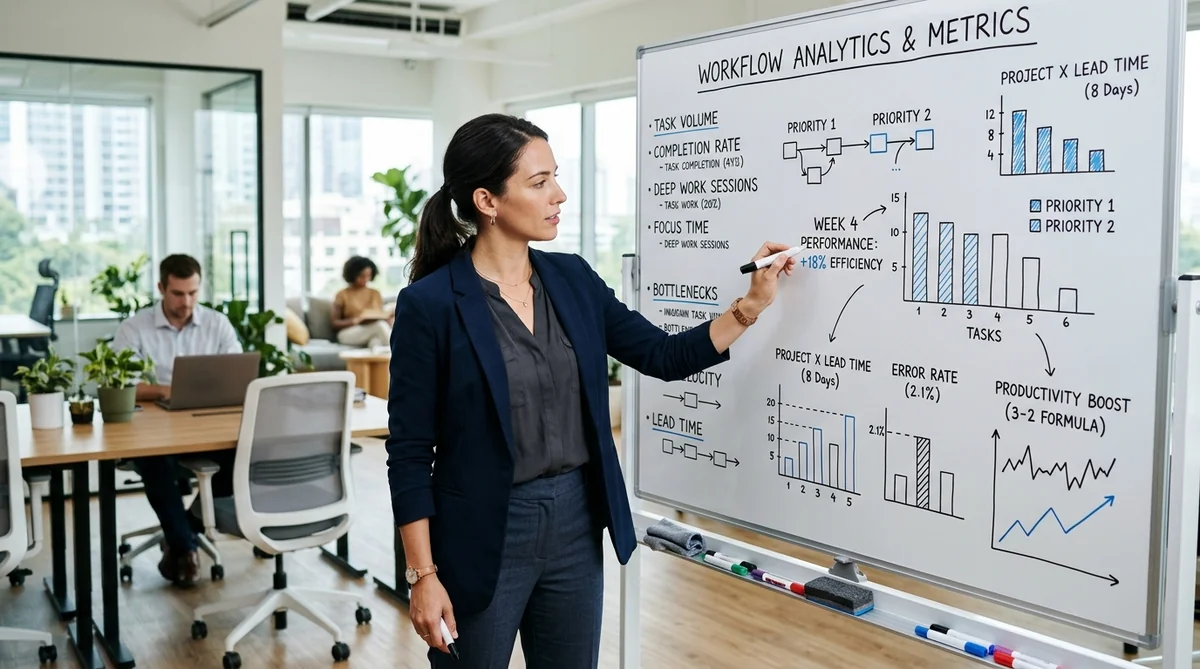
Strategic coordination: the office as a hub for dialogue, problem-solving, and mentoring.
The framework validated by Stanford does not encourage calendar anarchy; it establishes deliberate group coordination. Team members go to the office on the same three specific days —typically Monday, Tuesday, and Thursday— with the explicit purpose of connecting, resolving roadblocks, and aligning priorities.
In contrast, the other two days —Wednesday and Friday— are protected for working from home under a shared rule of zero hallway interruptions. This conscious boundary lets teams schedule four-hour deep work blocks to code, draft strategic plans, or analyze financial models without spontaneous disruption.
flowchart LR
    A[3-2 Workweek] --> B[Synchronous Days: Mon-Tue-Thu]
    A --> C[Asynchronous Days: Wed-Fri]
    B --> D[In-Person Collaboration and Mentoring]
    C --> E[Deep Focus at Home]
Focus is not the absence of distractions; it is having a project you care more about and a protected block of time where your ideas can take shape without artificial friction.
2. Quantitative Evidence and Execution Systems for Deep Focus
Executive doubts fade when empirical numbers demonstrate an undeniable advantage. Across six months of active field testing and two full years of post-trial evaluation, the research team tracked two cohorts: those under standard five-day office rules and those on the 3-2 hybrid schedule.
Research published in Nature confirmed that the hybrid framework slashed employee turnover by a third without harming technical performance, as verified in the Nature study on hybrid work.
| Evaluated Dimension | Control Group (5-Day In-Office) | Hybrid 3-2 Group (Stanford) | Measured Impact |
|---|---|---|---|
| Voluntary Quit Rate | Standard corporate attrition | Sharp decline in resignations | -33% quit rate (p < 0.01) |
| Performance Reviews and Promos | Regular biannual rating | Identical promotion pace | Zero statistical penalty |
| Engineering Code Output | Continuous on-site deployments | Equal quality and volume | Total performance stability |
| Managerial Productivity View | Initial drop estimate of -2.6% | Post-trial assessment | +1.0% perceived increase |
The working paper from the National Bureau of Economic Research on hybrid work affirms that structured flexibility protects team morale and cuts commute fatigue. Also, research on time management on Wikipedia shows that alternating synchronous blocks with asynchronous deep work shields creative attention.

Individual focus: an analog timer and clean desk space for deep work sessions.
Adopting a similar dynamic in your individual routine requires sober digital support that keeps visual clutter off your screen. You do not need to overwhelm your workflow with dozens of complex tools; you need simple systems that clearly separate coordination moments from solitary deep work blocks.
To structure your workweek with firm boundaries and safeguard your sharpest hours, lean into these practical anchors:
- Structured note hubs: clean panels where you separate team meeting notes from master project briefs requiring focused solitary drafting.
- Transparent tracking boards: workflows linking quarterly objectives with clear deliverables, making it easy to schedule which core deliverables happen on remote focus days.
- Analog desk anchors: a mechanical countdown timer on your desk establishes an unmistakable visual boundary: fifty uninterrupted minutes on a single priority before checking notifications.
Use this quick checklist to clear the runway before your workday accelerates:
- Meeting audit: Did I identify and cancel at least one unnecessary video call that could be resolved via an asynchronous written update?
- Batch synchronization: Did I cluster client calls and team syncs into a maximum of two or three specific days of the week?
- Protected calendar blocks: Did I block two morning deep focus slots with priority status to prevent surprise meetings?
- Response agreements: Did I agree with teammates on which issues require quick responses and which can wait two to three hours?
- Desk readiness: Is my workspace free from paper piles with my mechanical timer ready for the first focus sprint?
Routines that elevate your output do not feel heroic or punishing; they feel smooth, predictable, and sustainable throughout the year. Start with what you have on your desk today. When you organize your week around deep thinking intervals, you regain the satisfaction of shutting down your computer knowing you took real ground on what matters.
Frequently Asked Questions
Why Hybrid Outperforms Full Remote and Office
Because it balances social cohesion and teamwork during office days with the quiet solitude required for deep analytical thinking during home days.
How can teams convince skeptical leadership to test this model?
By proposing a three-month pilot with objective delivery milestones based on deliverables, rather than hours spent occupying a physical desk.
What should I do if teammates keep messaging me on remote focus days?
Agree on response windows in advance and turn on do-not-disturb status during morning concentration sprints.
Health and professional wellness notice: The perspectives and methods shared in this article are intended for educational purposes regarding work habits and daily organization, without substituting professional medical or clinical guidance.
Sources
- Stanford Institute for Economic Policy Research (SIEPR): Hybrid work is a win-win-win for companies, workers — Research on the 3-2 hybrid model, employee retention, and productivity across 1,600+ professionals.
- Stanford University Report: Study finds hybrid work benefits companies and employees — Research exploring intentional in-person coordination and performance preservation in technical teams.
- Nature: Hybrid working from home improves retention without damaging performance — Peer-reviewed publication (Nicholas Bloom et al., DOI: 10.1038/s41586-024-07500-2) examining hybrid workplace retention.
- National Bureau of Economic Research (NBER): How Hybrid Working From Home Works Out — NBER working paper examining schedule control and job satisfaction under two-day remote deep work.
- Wikipedia: Time Management — Fundamentals of schedule synchronization, block prioritization, and cognitive load prevention.
Written by Félix Soler
Wellness & Psychology Editorial Team
Personaje editorial de El Optimista. Comparte pequeños hábitos diarios para superar el cansancio, organizarte mejor y vivir con calma.
Thematic editorial persona backed by our human curation team.
Asynchronous Work: The Playbook That Cut 70% of Meetings and Freed 322,000 Hours
Morning Habits to Boost Daily Productivity and Focus