
Morning Habits to Boost Daily Productivity and Focus
Have you ever shut down your laptop at the end of the day feeling utterly exhausted, yet carrying the frustrating sense that you achieved nothing truly meaningf...


Table of Contents
- Physiology of Waking: Reactivity Versus Proactivity
- Habit 1: Light Synchronization and Circadian Reactivation
- Habit 2: Cellular Hydration and Brief Thermal Stimulation
- Body Micro-Activation: Elevating BDNF in 8 Minutes
- Habit 3: Attention Preservation and Notification Fasting
- Habit 4: Intentional Planning and the Single Priority Rule
- Habit 5: Clear Workspace and Physical Grounding
- Checklist: Your Morning Routine in 4 Phases
- Phase 0: The Night Before (Environment Preparation)
- Phase 1: Minutes 0 to 15 (Biological Reactivation)
- Phase 2: Minutes 15 to 35 (Quiet Personal Space)
- Phase 3: Minutes 35 a 60 (Intentional Focus and Launch)
- Frequently Asked Questions
- What time should I wake up to maximize productivity?
- Should I drink coffee immediately after waking up?
- How do I apply these habits if I have very little morning time?
- The Art of Starting with Calm
- Consulted Sources and Recommended Reading
Have you ever shut down your laptop at the end of the day feeling utterly exhausted, yet carrying the frustrating sense that you achieved nothing truly meaningful?
For a long time, my daily routine began by waking up at dawn, checking my inbox directly from bed, and spending the next two hours firefighting everyone else's urgent requests. I convinced myself that living in a state of chronic urgency was the ultimate proof of productivity. The actual outcome? Chronic neck tension, mental fatigue, and a desperate dependence on caffeine just to stumble into lunchtime.
The problem does not stem from a flawed character or a lack of willpower. The real breakdown happens when you surrender your first thirty minutes of wakefulness to external chaos. When your morning starts with social feeds, urgent chat pings, or frantic multitasking, you hijack your attention: reactive cortisol spikes and your executive energy burns out before you make a single conscious decision.
Sustainable productivity is not born from punitive discipline or rigid 5:00 a.m. boot camps. It emerges from synchronizing your biology with calm before screens turn on. In this comprehensive guide, I share the grounded morning routine that restored my mental clarity: simple, evidence-backed habits to nurture your vital energy, protect your cognitive bandwidth, and steer your workday with purpose from minute one.
Executive Summary (TL;DR): High-impact productivity does not demand extreme early wake-ups; it requires safeguarding your first sixty minutes. This proactive system rests on five operational pillars: circadian light synchronization, cellular electrolyte rehydration, attention protection through digital fasting, defining a single critical daily priority, and physical desk resets.
Physiology of Waking: Reactivity Versus Proactivity
How you open your eyes conditions your brain's performance for the next twelve hours. Reaching for a smartphone while still in bed triggers an immediate alarm response in the amygdala. You transition from restorative sleep to hypervigilant alertness in under ten seconds.
This reactive loop floods your neural circuits with cheap dopamine — the neurotransmitter of instant gratification — while driving up cortisol through artificial panic rather than natural biology. In contrast, an intentional start allows brainwaves to shift smoothly from alpha and theta rhythms into beta frequencies, which support serene, analytical focus. Understanding the mechanics of the circadian rhythm enables you to harmonize wakefulness with your body's innate hormonal peaks.
| Neurobiological Metric | Reactive Routine (Cheap Dopamine Loop) | High-Performance Mindful Routine |
|---|---|---|
| Attention Latency | Fragmented; unable to sustain 10 min of reading | Stable and deep; prolonged immersion |
| Basal Cortisol Curve | Artificial spike caused by external panic | Harmonious, natural waking surge |
| Decision Fatigue | High before 8:00 a.m. (social feeds, chats) | Near zero; frictionless preset flow |
| Sense of Control | Passive; persistent feeling of falling behind | Active; clear direction over daily goals |
💡 Consejo Pro
The Golden Morning Rule: If you surrender your first thirty minutes to a screen, you rent your brain out to other people's priorities for the rest of the day.
Habit 1: Light Synchronization and Circadian Reactivation

Your body does not tell time by looking at a wall clock; it decodes the day through the retinal ganglion cells in your eyes. Exposing your eyes to natural daylight shortly after leaving bed suppresses melatonin production and sets your internal biological timer.
According to clinical research on light exposure and circadian synchronization by Leproult et al., receiving bright morning light produces a 35% to 50% increase in the natural morning cortisol peak. Far from triggering anxiety, this physiological rise clears sleep inertia and ignites wakefulness without relying on chemical stimulants.
By contrast, artificial screen glare emits a narrow blue spectrum incapable of replicating solar photons. As detailed in Harvard Medical School investigations on light cycles and biological rhythms, calibrating daytime light exposure stabilizes mood neurotransmitters and safeguards restorative deep sleep for the following night.
If you live in a region with dark winters or work in a windowless room, consider bio-lighting solutions: a 10,000-lux full-spectrum desk lamp or a sunrise alarm clock can effectively bridge the daylight gap.
Habit 2: Cellular Hydration and Brief Thermal Stimulation

You spend approximately eight hours exhaling water vapor with every breath without replenishing fluids. That heavy, sluggish sensation in your eyes upon waking rarely indicates systemic burnout; it almost always signals mild overnight cellular dehydration.
Before brewing coffee, your body requires plasma volume restoration and electrolyte balance:
- Fill a large glass with lukewarm water (400 to 500 ml).
- Add a tiny pinch of unrefined sea salt to provide essential bioavailable sodium and trace minerals.
- Squeeze in a few drops of fresh lemon juice to enhance taste and stimulate gentle digestive enzymes.
Once rehydrated, activate your sympathetic nervous system with a brief thermal stimulus. You do not need an ice bath: splashing cold water onto your face for thirty seconds or ending your morning shower with thirty seconds of cool water achieves a comparable physiological reset.
As demonstrated by Srámek and colleagues in their thermal regulation experiments, cold exposure elevates plasma dopamine concentrations by 250% and norepinephrine by over 500%. Unlike synthetic energy drinks, this neurochemical lift lasts for hours without triggering afternoon energy crashes.
Body Micro-Activation: Elevating BDNF in 8 Minutes
Waking up your musculature does not require exhausting fasted gym sessions. A short mobility sequence stimulates Brain-Derived Neurotrophic Factor (BDNF) — a crucial protein for neuroplasticity and working memory. Research in exercise neurobiology confirms this brief activation can raise basal BDNF levels four- to five-fold.
Choose one of three adaptable options:
- Option A (Joint Mobility Flow): Eight minutes combining shoulder circles, cat-cow stretches, and gentle hip openers on a mat.
- Option B (Brisk Neighborhood Walk): Ten minutes of brisk walking outdoors, pairing physical movement with direct daylight capture.
- Option C (Dynamic Activation): Three quick sets of bodyweight squats and hip flexor stretches to relieve spinal stiffness from sleeping.
Habit 3: Attention Preservation and Notification Fasting
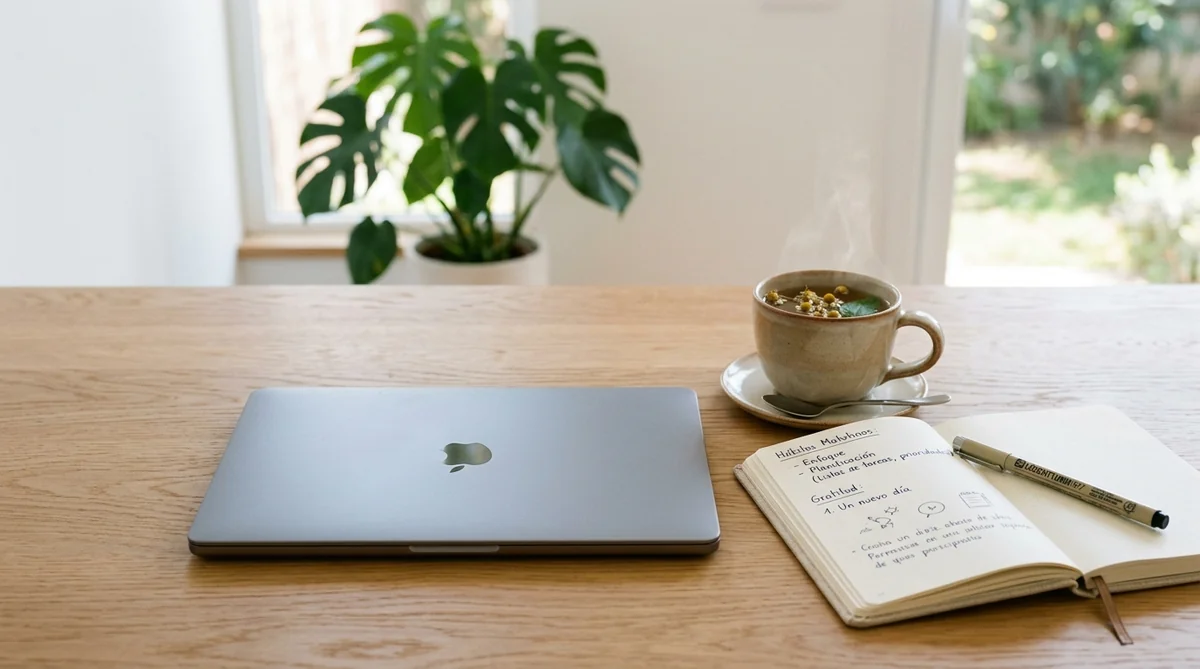
Willpower and analytical attention are finite metabolic resources. The pioneering studies by Roy Baumeister on ego depletion and self-control demonstrated that the prefrontal cortex burns energy with every decision it makes, no matter how trivial.
If you spend your first waking hour answering non-urgent messages, skimming inflammatory headlines, and reacting to social media threads, you burn through your best cognitive fuel before your primary work even starts.
📌 Importante
Cognitive Hijack Warning: Consuming alarmist news or work messaging during your first forty-five minutes awake induces a state of chronic reactivity, undermining the composure required for strategic problem-solving.
Shield your cognitive reserves with an intentional digital fast:
- Charge your phone outside the bedroom overnight or keep "Do Not Disturb" active until 8:30 a.m.
- Use desktop blocking apps — such as Freedom or operating system focus modes — to keep inboxes muted.
- Guard your first forty-five minutes solely for yourself, your thoughts, and your quiet personal preparation.
Habit 4: Intentional Planning and the Single Priority Rule

The most common trap in personal productivity is confusing frenetic activity with meaningful progress. Opening email the moment you sit down surrenders your agenda to other people's demands, turning your entire day into an endless firefighting drill.
Before launching your browser, grab a physical notebook or open your digital task manager (such as Notion or Todoist) to define your Critical Daily Task (CDT):
- Clearly identify the single deliverable that, once completed, will make the day an undeniable success.
- Break that priority down into two or three tangible, sequential action steps.
- Apply timeboxing: reserve an uninterrupted 60- to 90-minute deep work block early in the day to execute that priority without open distractions.
By finishing your most demanding intellectual challenge before 10:00 a.m., you instantly relieve cognitive pressure for the rest of the workday.
Habit 5: Clear Workspace and Physical Grounding

Visual clutter across your desk silently competes for neural bandwidth. Tangled cables, leftover mugs, and scattered paperwork send an ongoing signal of unresolved obligations to your brain.
Organizing your work station is a tangible act of respect toward your own focus:
- Evening Reset (3 Minutes): Every evening, file loose notes, clear the desk surface, and lay out only the tools needed for your first morning task.
- Functional Ergonomics: Adjust your office chair to keep elbows at ninety degrees and position your screen at eye level to eliminate cervical strain.
- Friction Reduction: If your first task is drafting a report or analyzing data, leave that document open and your pen resting on your notebook.
Stepping into an orderly workspace each morning sends an unmistakable signal of agency: you arrive to create with clarity, not to battle clutter.
Checklist: Your Morning Routine in 4 Phases
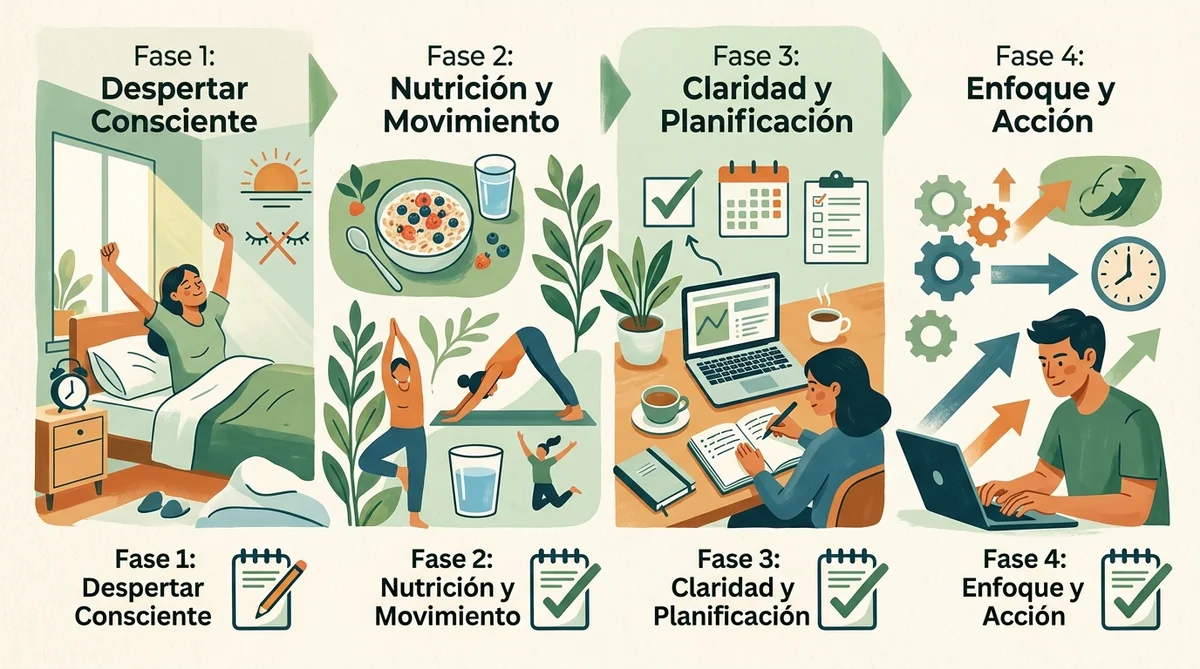
Save this checklist in your personal notes to guide your mornings over the next seven days:
Phase 0: The Night Before (Environment Preparation)
- Shut down digital screens sixty minutes before bedtime.
- Clear your desk, leaving an open notebook and pen ready.
- Plug your phone in to charge outside the bedroom.
Phase 1: Minutes 0 to 15 (Biological Reactivation)
- Rise immediately without hitting the snooze button.
- Drink 500 ml of lukewarm water with a pinch of sea salt and lemon juice.
- Step onto a balcony, patio, or window for five to ten minutes of natural daylight.
- Splash your face with cold water for thirty seconds to dissipate sleep inertia.
Phase 2: Minutes 15 to 35 (Quiet Personal Space)
- Complete six to eight minutes of gentle mobility or a brisk walk.
- Eat a peaceful breakfast or savor a warm beverage without screens.
- Keep group chats, inboxes, and social media feeds completely muted.
Phase 3: Minutes 35 a 60 (Intentional Focus and Launch)
- Write down your Critical Daily Task (CDT) in your notebook or project board.
- Activate focus mode on your computer.
- Complete your first uninterrupted 60-minute deep work block.
Frequently Asked Questions
What time should I wake up to maximize productivity?
You do not need to wake up at 5:00 a.m. What matters most is securing seven to eight hours of restorative sleep and respecting your natural chronotype. Regularity and focused intention are far more valuable than cutting sleep short.
Should I drink coffee immediately after waking up?
Drinking coffee within your first sixty minutes blunts your natural morning cortisol rise and temporarily masks adenosine receptors. This disruption frequently triggers the classic energy crash experienced around 2:00 or 3:00 p.m.
How do I apply these habits if I have very little morning time?
Focus on chained micro-habits that take three to five minutes: open your curtains wide, drink your glass of salted water, and write down your top priority before touching your phone. Consistency matters far more than duration.
The Art of Starting with Calm

We often punish ourselves with the belief that we lack discipline, when what we actually lack is thoughtful morning architecture. Trying to overhaul every minute of your life overnight only breeds frustration and burnout.
Real productivity is not about cramming more tasks in before sunrise. It is about doing what genuinely matters to protect your tranquility and sustain your cognitive stamina.
The habits that transform your routine rarely feel heroic or flashy. They feel quiet, almost invisible, like deep roots anchoring everything you build throughout the day. Start where you are today: pick just one habit from this guide — stepping outside for ten minutes of natural light or postponing email — and sustain it for seven days.
You will discover how mental clarity returns naturally, without pressure and in its own steady rhythm.
Health and professional wellness disclaimer: The reflections and methods shared in this article are intended for educational purposes regarding workplace organization and daily habits, without constituting medical or clinical advice.
Trademark notice: The trademarks, service marks, and software names referenced (including Notion, Todoist, Freedom) belong to their respective owners. Their mention in this article is solely for nominative educational identification under fair use principles, implying no commercial endorsement or affiliation.
Consulted Sources and Recommended Reading
- Leproult et al.: Clinical Evidence on Light Exposure and Circadian Synchronization — Controlled study on early photic stimulation, cortisol waking response, and circadian alignment.
- Harvard Medical School: Research on Light Cycles and Biological Rhythms — Analysis of natural daylight benefits versus blue screen light on melatonin and mood stability.
- Srámek et al.: Physiological and Hormonal Responses to Cold Thermal Stimulation — Clinical measurement of sustained dopamine and norepinephrine increases following cold exposure.
- Baumeister et al.: Research on Ego Depletion and Executive Decision Fatigue — Foundational paper on finite cognitive willpower and prefrontal fatigue.
- Wikipedia: Circadian Rhythm and Biological Regulation — Comprehensive overview of 24-hour endogenously driven biochemical oscillations.
Written by Félix Soler
Wellness & Psychology Editorial Team
Personaje editorial de El Optimista. Comparte pequeños hábitos diarios para superar el cansancio, organizarte mejor y vivir con calma.
Thematic editorial persona backed by our human curation team.

Task Management and Deep Work with the Hybrid Formula
Crush Brain Fog: The Ergonomic Setup That Reclaims Your Focus