
The 5-Second Method to Unblock Your Workday
Learn how to overcome screen paralysis by combining the 5-4-3-2-1 rule and 5-minute micro-habits to make smooth progress on your work.


Table of Contents
- Why procrastination isn't laziness, but emotional friction
- The trap of screen-based hedonic repair
- What activation energy is and why it slows your morning
- 5-4-3-2-1 rule vs. 5-minute rule: how they differ
- The 5-second physical launch trigger
- The 300-second commitment versus the classic Pomodoro technique
- Architecture of the launch: how your brain moves from paralysis to momentum
- From initial block to the Zeigarnik effect in 3 steps
- How to leverage open loops without overloading your agenda
- Step-by-step methodology to apply the system at your desk
- Define a micro-goal impossible to refuse
- Execute the countdown and sustain 5 minutes without editing
- Ecosystem of lightweight tools to protect your initial focus
- Visual timers and distraction blockers
- Quick capture systems to empty mental pendings
- Myths and common mistakes when trying to work with micro-habits
- Confusing the gentle startup with a productivity marathon
- Leaving notifications open during the 5-minute window
- How to scale from 5 minutes to sustained deep work blocks
- Synchronize the micro-startup with your natural energy peaks
- Closing rituals to resume projects the next day
- Quick action matrix based on your workday block type
- Frequently asked questions about the 5-second system
- What do I do if the 5 minutes ring and I still don't feel like continuing?
- Does it work the same for creative tasks as for operational work?
- How many times a day should I use the countdown?
- Your first startup block begins today
- Sources
Staring at a blinking cursor on a blank screen drains more energy than 2 hours of focused work. That initial paralysis doesn't vanish with flawless planners or motivational speeches.
You dismantle it by hacking your brain's mechanical switch before it builds the first excuse.
Focus isn't a static gift. It's the decision you make when you open your laptop—and especially when twenty open tabs compete for your attention.
In this guide you'll discover how to combine 2 practical tools: the 5-second countdown to beat physical blocks and the 5-minute micro-habit to maintain momentum without burning out.
Why procrastination isn't laziness, but emotional friction
Most people think postponing a report or presentation is a poor time management issue. Yet the clock is rarely the real obstacle.
The block appears because your mind interprets that pending task as a threat of boredom, confusion, or a potential mistake. When the brain detects that discomfort, it seeks a quick exit to feel better instantly.

🎨 Conceptual editorial illustration generated by AI for El Optimista.
| Phase | Key action |
|---|---|
| Trigger | 5-4-3-2-1 count |
| Launch | 5-minute block |
The trap of screen-based hedonic repair
In behavioral psychology, this detour has a specific name: short-term hedonic repair. It's the reflex impulse to postpone a demanding task by opening social media, checking email, or cleaning the desk to soothe the tension of the moment.
Think of it as taking a pill to relieve a quick stab of pain. It takes away the annoyance for the next few minutes, but it doesn't solve the project waiting for you in the afternoon.
Reviews on emotional regulation and procrastination confirm that we don't avoid work out of laziness. We do it to escape the uncomfortable emotion that a specific task triggers in us.
What activation energy is and why it slows your morning
The second invisible brake is activation energy. It's the initial push needed to get any activity moving before momentum works in your favor.
Imagine you need to push a stalled car on a flat street. Moving it the first inch requires pushing with your whole body, but once the wheels turn, you can keep it rolling with one hand.
Your workday works the exact same way. The mental cost of opening the file and writing the first line is extremely high. Yet sustaining the rhythm at minute 6 feels surprisingly light.
5-4-3-2-1 rule vs. 5-minute rule: how they differ
It's very common to mix up both concepts under the same label, even though they serve different functions in your daily routine. Using the wrong method at the wrong time explains why many productivity attempts fail by the third day.
The 5-second physical launch trigger
The well-known 5 Second Rule, popularized by Mel Robbins, works as an immediate neurobehavioral trigger.
It involves counting backward—5, 4, 3, 2, 1—at the exact instant you feel the impulse to act on a task you're avoiding.
Counting in reverse requires active concentration and cuts mental rumination short. Before your brain invents an excuse to check your phone, the number 1 forces you to move your hands toward the keyboard.
The 300-second commitment versus the classic Pomodoro technique
On the other hand, the 5-minute rule comes from cognitive-behavioral strategies to overcome effort aversion. It doesn't ask you to finish the entire project. Instead, it asks you to commit to working on it for just 300 seconds.
Unlike the classic Pomodoro technique—which structures your entire day into rigid 25-minute blocks—the 5-minute micro-habit serves exclusively to break initial paralysis. If when the timer goes off you want to stop, you have total permission to do so.
| Practical dimension | 5-4-3-2-1 Rule | 5-Minute Rule | Classic Pomodoro Technique |
|---|---|---|---|
| Main objective | Cut doubt and launch | Reduce starting friction | Sustain long blocks |
| Method duration | Exact 5 seconds | 5 minutes (300 seconds) | 25 minutes of work |
| Usage moment | Before touching the keyboard | When starting a heavy task | During fluid work sessions |
| Exigency level | Minimal (movement only) | Low (allows stopping later) | Medium-high (requires rhythm) |
💡 Consejo Pro
Don't pick just one technique. Use the 5-4-3-2-1 countdown as the car's ignition key, and the 5 minutes as first gear to pull out of the parking lot.
Architecture of the launch: how your brain moves from paralysis to momentum
Understanding what happens inside your head during those first few minutes takes a huge weight off your shoulders. You stop demanding infinite willpower and start designing an environment where making progress is as easy as possible.
From initial block to the Zeigarnik effect in 3 steps
Once you get past the countdown and write the first paragraph or reply to the first email, the Zeigarnik effect enters the scene. It's the brain's natural tendency to remember and keep active tasks that have already started but remain incomplete.
It works just like watching the first episode of a series with an open ending. Even if you didn't feel like watching it before, your mind stays hooked wanting to know the outcome.
Analysis on the Zeigarnik effect in work execution shows that starting a task by leaving a rough sentence on the screen creates an open loop.
Your mind feels a slight discomfort leaving that work half-done and naturally pushes you to complete it.
flowchart LR
    A[Paralysis facing the project] --> B[Physical countdown 5-4-3-2-1]
    B --> C[Minimum 5-minute action]
    C --> D[Zeigarnik effect activates]
    D --> E[Natural momentum without friction]
How to leverage open loops without overloading your agenda
That said, the Zeigarnik effect also has a delicate side if you open ten fronts at the same time. Keeping too many tasks started halfway in your mind generates constant noise and overwhelm.
To avoid it, apply the 5-minute launch to a single priority deliverable each morning. Leave the rest of your pending items noted on paper so your memory stays clear.
Step-by-step methodology to apply the system at your desk
The routines that spark your productivity don't feel heroic; they feel fluid and natural. You don't need to redesign your life or wake up early by force to test this system today right at your desk.
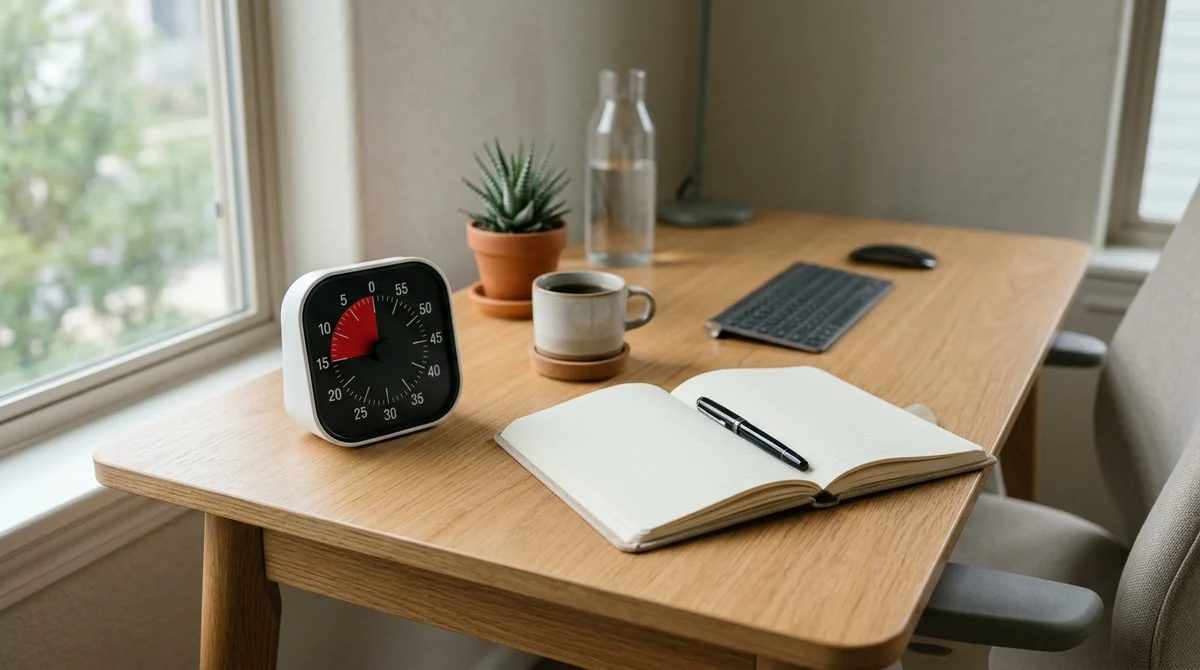
🎨 Conceptual editorial illustration generated by AI for El Optimista.
Define a micro-goal impossible to refuse
The number one mistake when sitting down to work is writing giant goals in the planner, like "do the quarterly report." That phrase is so ambiguous that your brain perceives it as an impossible mountain and prefers to open another tab.
Transform that mountain into a tiny, concrete step. Instead of "prepare the presentation," define "open the file and write the 3 main slide titles."
Execute the countdown and sustain 5 minutes without editing
When you identify that tiny step, close your email or messaging tabs for a moment. Look at your screen, count 5-4-3-2-1 under your breath, and put your hands on the keyboard without waiting to feel inspired.
During those initial 5 minutes, forbid yourself from editing, searching for secondary sources, or judging the quality of your progress. The only goal of this window is to produce an imperfect draft that breaks the ice of the blank page.
Follow this quick checklist before your first work block of the day:
- Pick a single task you've been postponing for days.
- Reduce its first step to a physical action under 2 minutes.
- Silence your phone and close tabs unrelated to your current file.
- Run the 5-4-3-2-1 countdown without negotiating with yourself.
- Turn on a 5-minute timer and move forward without fixing errors.
💡 Consejo Pro
If when the 5-minute alarm rings you still feel total blockage, stop without guilt. You'll have kept your honesty pact with yourself and next time your brain will trust the method.
Ecosystem of lightweight tools to protect your initial focus
You don't need to spend on complex platforms to apply startup micro-habits. Often, excess configurations and menus become just another elegant excuse not to start real work.
Visual timers and distraction blockers
To measure your initial 5 minutes, the ideal approach is to take the clock away from your phone. Using your cell phone's stopwatch usually ends in an automatic check of messages before even starting the countdown.
A physical desk timer or a simple browser extension serves the function much better. By watching time run in silence, your attention understands that effort has a clear, nearby limit.
Quick capture systems to empty mental pendings
When you enter your 5-minute block, it's normal for your mind to remember urgent things: paying a utility bill, replying to a client, or buying coffee. If you get up to resolve them, you break the momentum you just gained.
Always keep a physical notebook or a quick note open in a corner to write down that distraction and return. Emptying the idea onto paper frees up your working memory in 3 seconds.
| Tool category | Relative investment | Main advantage (✅) | Consideration limit (❌) |
|---|---|---|---|
| Physical notebook and pen | $ Entry | Zero notifications or screens | Doesn't sync if working away |
| Basic web timer | $ Entry | Immediate start from browser | Requires closing other tabs |
| Physical desk clock | $ Balance | Separates time from phone | Takes up fixed table space |
| Site and app blocker | $ Balance | Cuts social access for hours | Demands prior list setup |
| All-in-one suite (Notion) | $$p High End | Centralizes projects and notes | Slow adjustment curve at first |
Myths and common mistakes when trying to work with micro-habits
When a technique sounds this simple, it's easy to underestimate it or apply it with the wrong expectations. Identifying these traps early prevents you from abandoning the habit in the first week.

🎨 Conceptual editorial illustration generated by AI for El Optimista.
Confusing the gentle startup with a productivity marathon
Many professionals use the 5-minute trick hoping to turn into unstoppable machines working 4 hours straight without breathing. That rigid expectation reactivates the fear of effort before starting.
Practical guides on applying the 5-second rule show that the method's real value lies in changing the instant's inertia, not in forcing marathon sessions.
Leaving notifications open during the 5-minute window
Trying to start a difficult task while Slack, WhatsApp, or email alerts roll in is like trying to fill a bucket with a perforated bottom. Each sound resets your activation energy cost from scratch.
Observe the contrast between what we usually believe and what happens in practice:
- Myth: "If I'm only working 5 minutes, it's not worth silencing anything." Reality: A single alert at minute 2 destroys momentum before the Zeigarnik effect takes control.
- Myth: "I need to feel motivated to do the countdown." Reality: Action generates motivation, almost never the other way around.
- Myth: "If I stop at 5 minutes, I wasted time." Reality: Those 5 minutes reduce fear of the task and make picking it up later much simpler.
How to scale from 5 minutes to sustained deep work blocks
The startup micro-habit is the entry door, not the ceiling of your performance. Once you master the art of starting without drama, the next step is leveraging that momentum to protect your most valuable hours.

🎨 Conceptual editorial illustration generated by AI for El Optimista.
Synchronize the micro-startup with your natural energy peaks
Not all hours of the day yield the same results in front of the computer. Trying to apply your 5-minute startup to a complex project right after lunch demands twice the friction as doing it during your morning clarity peak.
Pinpoint the 2 hours of the day when your mind processes information best. Reserve the countdown for that specific block.
Executive profiles on leadership habits and decision making point out that those who achieve greater daily consistency don't rely on inspiration streaks, but on short windows of firm decision aligned with their real rhythm.
Closing rituals to resume projects the next day
The best trick to ease your morning startup is built today before turning off the screen. Never close a project at a dead stop where you don't know what comes next.
Dedicate the last 2 minutes of your workday to writing a quick note at the top of the document. When you return to your desk, your brain will have an immediate foothold to launch the countdown without hesitation.
💡 Consejo Pro
Taking care of your work rhythm also means knowing when to stop. Finishing on time and disconnecting in the afternoon protects the mental clarity you'll need the next day.
Quick action matrix based on your workday block type
Not every day you stall for the same reason. Sometimes the problem is perfectionism; other times, it's simply accumulated fatigue after a morning full of video calls.
Use this matrix as a quick reference guide when you feel stuck in front of the monitor:
| Current block type | Symptom in front of the screen | 5-minute micro-goal | Recommended immediate action |
|---|---|---|---|
| Perfection paralysis | You rewrite the first line 5 times | Draft a rough version without edits | Hide the format bar and write continuously |
| Size overwhelm | The project looks endless | List only the first 3 subtasks | Pick the shortest subtask and run 5-4-3-2-1 |
| Post-meeting fatigue | You stare at the monitor blankly | Organize files or clean 3 emails | Drink water, breathe deep, and do a soft block |
| Digital distraction | You jump between 15 open tabs | Close everything except one single document | Turn on phone airplane mode for 5 minutes |
Frequently asked questions about the 5-second system
What do I do if the 5 minutes ring and I still don't feel like continuing?
Stop exactly as you agreed with yourself. Keeping your word is more valuable for your confidence than forcing extra time.
Does it work the same for creative tasks as for operational work?
Yes, although in creative tasks it's best to focus on generating volume without judging initial quality. In operational work, the 5-minute approach usually resolves the pending item entirely before the alarm sounds.
How many times a day should I use the countdown?
Use it exclusively during difficult transition moments, like opening the computer in the morning or returning from lunch.
Your first startup block begins today
| Time of Day | 5-Minute Micro-Action | Closing Rule |
|---|---|---|
| Morning | Open the file and write 3 lines | Zero inbox before |
| Afternoon | Count 5-4-3-2-1 and clear 1 block | Short break on finish |

🎨 Conceptual editorial illustration generated by AI for El Optimista.
It's not about filling your schedule with secondary tasks to feel like you worked hard. It's about finishing what truly matters without spending your energy fighting indecision.
Start with what you have on your desk today. Pick that small task you've been postponing since yesterday, close extra tabs, count 5-4-3-2-1, and give yourself 5 honest minutes of real progress.
Legal and disclaimer notice: This article does not replace the consultation, diagnosis, or treatment of a certified physician or health professional.
Sources
- The 5 Second Rule — Mel Robbins
- The Zeigarnik Effect in Workplace Execution — Minutes of Smart
- Procrastination is not a time problem: it is a feelings problem — Barris Review
- The 5 Second Rule: Book Overview and Takeaways — Shortform Books
- This Mel Robbins' '5 Second Rule' for success — The CEO Magazine
Written by Félix Soler
Wellness & Psychology Editorial Team
Personaje editorial de El Optimista. Comparte pequeños hábitos diarios para superar el cansancio, organizarte mejor y vivir con calma.
Thematic editorial persona backed by our human curation team.

Detox de dopamina sin extremos: recupera tu enfoque diario
5-minute real break: the reset your afternoon needs