
5-minute real break: the reset your afternoon needs
Discover why forcing concentration drains your workday and how five minutes of screen-free pauses trigger a real brain reset.


Table of Contents
- The trap of keeping on when your mind has already stalled
- What happens in your brain during 5 minutes without screens
- The evidence behind the brief reset
- Why your internal autopilot cleans up your attention
- Fake digital rest versus a real restorative break
- Myth and reality about clearing your head with your phone
- What a micro-break actually solves and what it doesn't
- A 2-minute micro-habit to rescue your afternoon today
- Sources
You've spent forty minutes staring at the same draft without stringing together a clear idea. Instead of stopping, you force yourself to keep going—convinced that leaving your chair for 5 minutes means losing your rhythm.
Forcing concentration with a saturated mind doesn't multiply your progress. It just manufactures mistakes that take twice as long to fix later in the day.
The way out doesn't require retreats or impossible routines. A 2-minute micro-habit without screens—acting as a gateway to a real five-minute break—is enough to reset your focus and rescue your afternoon right now.
The trap of keeping on when your mind has already stalled
There's a deeply rooted belief in offices and remote teams: whoever spends the most hours glued to the keyboard shows the greatest commitment. That myth confuses physical endurance with genuine mental clarity.
When you chain demanding tasks together without breathing, the Time-on-Task (TOT) effect appears. This is the measurable decline in your mental speed, precision, and work morale from going non-stop.
Think of it like driving on a highway with an unaligned tire. At first you barely notice it, but by the third stretch the steering wheel vibrates and the wear forces you to slow down.
Focus isn't the absence of breaks. It's knowing how to stop for 5 minutes before your judgment starts taking clumsy shortcuts.
Your executive attention—that capacity to filter distractions, decide calmly, and sustain a thread in a complex file—works just like a flashlight battery in pitch darkness.
If you keep it at maximum without resting, the light doesn't just snap off. It loses reach until it barely illuminates the ground right in front of your feet, just when you need to see the big picture most.
When you analyze the most productive workdays, it's clear that the 4:00 PM slump rarely stems from a lack of discipline—it's simply biological saturation disguised as laziness.

What happens in your brain during 5 minutes without screens

🎨 Editorial illustration: Brief visual disconnect scene away from the monitor to activate cognitive rest during the workday.
The evidence behind the brief reset
Stopping for a short time feels insignificant against an endless to-do list. However, data shows that duration matters far less than the quality of the break.
A meta-analysis published in ScienceDaily evaluated the impact of micro-breaks under 10 minutes in the workplace. Results confirmed that these breathers reduce perceived fatigue and boost daily vigor.
Plus, a study in Frontiers in Psychology revealed that 3 to 5 minutes without digital stimuli are enough to achieve real psychological detachment, improve mood, and recharge attention.
Why your internal autopilot cleans up your attention
When you look away from the monitor and leave your mind free of immediate goals, a key handoff occurs. The Default Mode Network (DMN) lights up as a brain circuit dedicated entirely to active rest.
As explained in research on the Default Mode Network, this system works right when you stop demanding quick answers from your prefrontal cortex.
It functions like background maintenance on a laptop. While you let go of the keyboard, the machine cleans temporary memory so programs can open again without freezing.

💡 Consejo Pro
Golden rule for your break: Step at least 6 feet away from any screen for 5 minutes. Looking at a distant point out the window relaxes your vision and lets your nervous system know the alert has ended.
Another Frontiers in Psychology analysis highlights a key insight. Accumulating frequent micro-breaks beats waiting for a long rest at the end of the day, keeping exhaustion from turning into an unpayable debt.
Fake digital rest versus a real restorative break
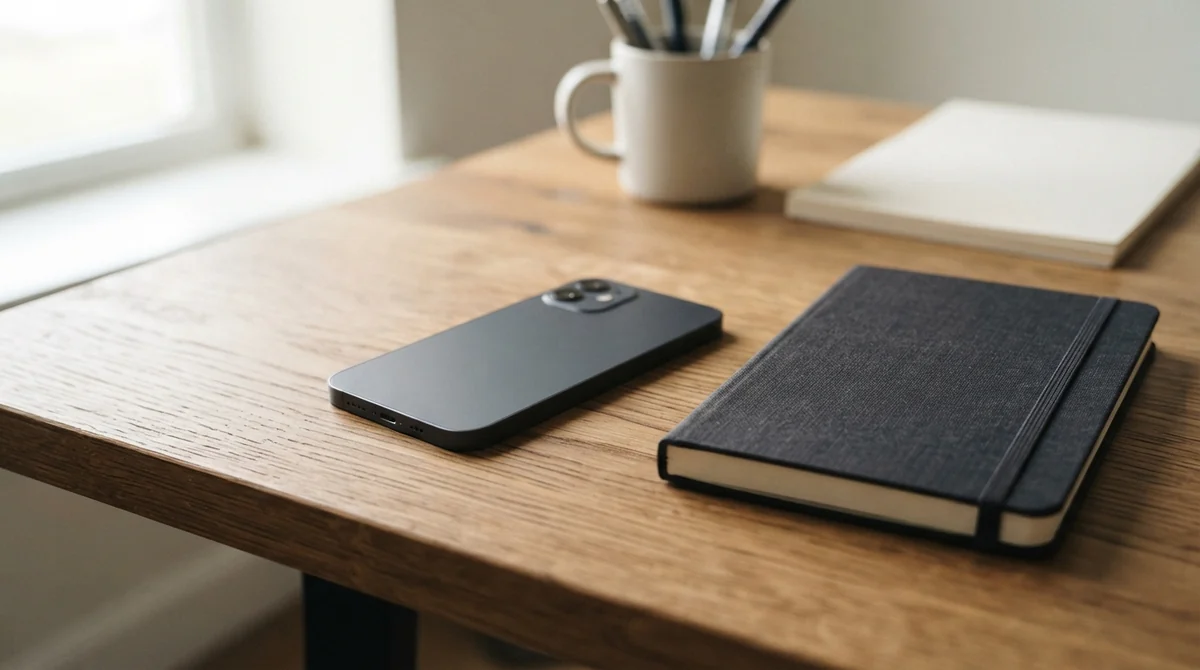
🎨 Editorial illustration: Physical separation from the phone during a micro-break to avoid fake digital rest.
Myth and reality about clearing your head with your phone
This is where most of us stumble without realizing it. We think swapping a demanding report for 5 minutes of social media or personal messages equals resting the mind.
That habit is a fake digital rest. When you scroll fast, your brain keeps processing text, lights, and emotional stimuli that exhaust the exact same attention circuits you were trying to soothe.
- Conventional myth: Checking the news or short videos on your phone clears your head between meetings because it isn't formal work.
- Empirical reality: Switching screens keeps dopaminergic consumption active and stalls recovery; only real sensory disconnection of 3 to 5 minutes restores executive focus.
What a micro-break actually solves and what it doesn't
It's best to keep your feet on the ground and avoid magic recipes.
As a report on micro-breaks in The Times of India summarizes, 5 minutes are enough to give a tired brain a reset in the middle of the workday.
However, the evidence also draws a clear limit. These short breaks dispel momentary exhaustion and return agility for routine tasks, but they don't compensate for poor sleep or impossible workloads.
Treat them as a daily firebreak. They protect your clarity between work blocks, never as an excuse to stretch the workday into the night.
A 2-minute micro-habit to rescue your afternoon today
You don't need to redesign your entire calendar or download another timer app to notice a difference today. Friction appears when you try to change too much at once.
That's why starting with a minimal 2-minute anchor works so well. Right after sending your next long email—or when you notice you're rereading the same sentence for the third time—close your laptop lid and leave your phone face down.
| Step | Screen-free action | Time |
|---|---|---|
| 1. Cut | Close your laptop and leave your phone face down | 15 seconds |
| 2. Step away | Walk to a window or pour a glass of water in silence | 2 minutes |
| 3. Unwind | Let your thoughts wander without solving anything | 3 minutes |
Stand up, walk to a window, or pour yourself a glass of water in silence, letting your thoughts wander without solving anything. Those first 120 seconds break the chair's inertia; almost effortlessly, you'll want to stretch the break to complete the 5 minutes.
When you return to your desk, you'll notice the mental knot has loosened and the next decision takes half the energy.
How would your afternoon change if you gave yourself two real, screen-free breaks today before logging off?
Sources
- ScienceDaily — 'Micro-breaks' from tasks show promise in boosting wellbeing
- PMC / Frontiers in Psychology — Do micro-breaks between study sessions enhance concentration?
- Frontiers in Psychology — Micro-breaks and attentional recovery in demanding sessions
- Neuromind — Default Mode Network: Functions, Regions & Research
- The Times of India — Just 5 minutes can reset your brain: What scientists found about micro-breaks
Written by Félix Soler
Wellness & Psychology Editorial Team
Personaje editorial de El Optimista. Comparte pequeños hábitos diarios para superar el cansancio, organizarte mejor y vivir con calma.
Thematic editorial persona backed by our human curation team.