
Smart Rings: Why Professionals Are Ditching Wrist Screens at Work
How many times did your wrist buzz this morning while you were hammering out a critical proposal? Every flash of light on your smartwatch halts your train of th...

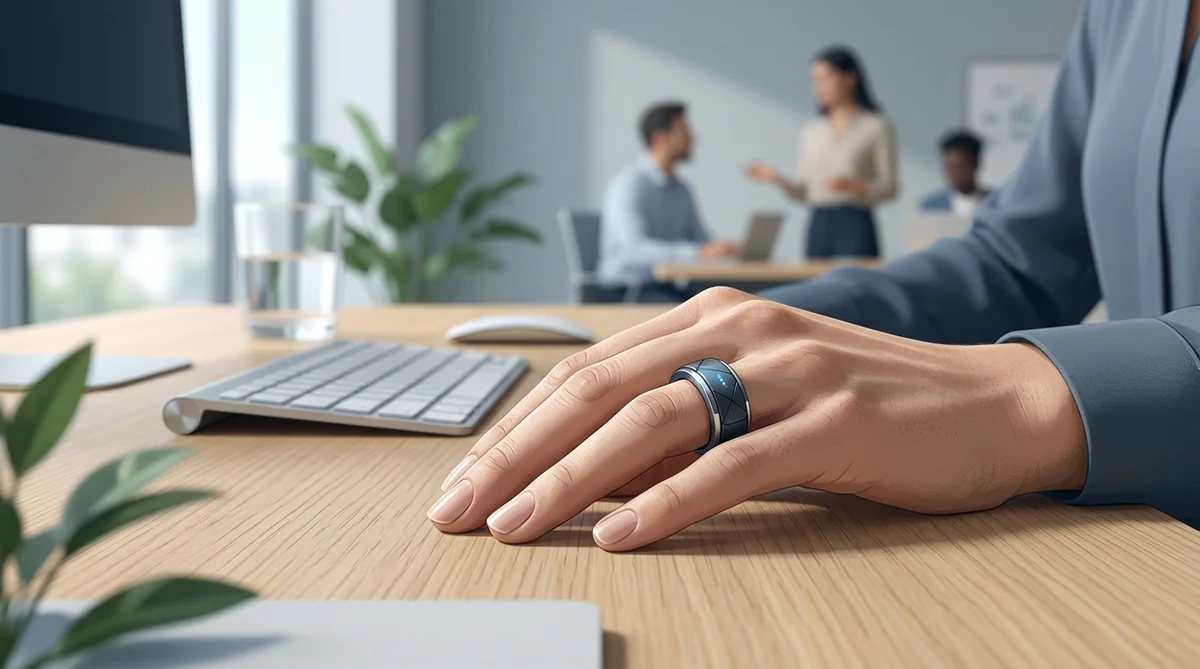
Table of Contents
How many times did your wrist buzz this morning while you were hammering out a critical proposal? Every flash of light on your smartwatch halts your train of thought in its tracks. It inflicts a quiet micro-interruption that shreds your creative flow well before lunchtime.
That visual overload is triggering a quiet rebellion across office desks: high-output professionals are actively removing screens from their bodies. The global smart ring market surpassed $416 million in 2025 and is projected to expand at a compound annual growth rate of 29.30% through 2034. That momentum isn't a tech gimmick; it stems from an urgent need to reclaim operational silence during the workday.
This isn't about ignoring your performance data. It is about embracing invisible tech: passive sensors that log physiological metrics in the background, without flashing OLED panels that demand your attention or competing for your most valuable asset at the office: sustained focus.
The Focus Deficit: Why Screen-Heavy Watches Wore Us Out
For nearly a decade, we accepted a flawed bargain: strapping a miniature smartphone touchscreen directly over our pulse. What started as a promise to simplify our schedules slowly turned into an endless source of friction between meetings, calls, and analytical deep work.
The standard smartwatch turned your wrist into an uncurated inbox. Low-priority pings, calendar nudges, and promotional emails constantly battle for your cognitive bandwidth. In a standard workday, that dynamic breeds friction that most knowledge workers know all too well:
- Fractured deep work: Every buzz triggers a sensory reflex that breaks focus, requiring 15 to 20 minutes to rebuild momentum on complex tasks.
- Meeting room micro-stress: Glancing down at your wrist while a client is speaking radiates subtle impatience.
- Hypervigilance fueled by visual cues: Activity rings encourage compulsive monitoring, rewarding quick dopamine hits over high-use execution.
Invisible technology stepped in to fix this exact strain. The goal isn't to bolt another touch screen onto your morning routine, but to move data capture out of your line of sight. A passive sensor logs your metrics without unnecessary buzzing, never asks to be tapped, and hands you back full control over your most productive hours.
The Finger vs. The Wrist: Anatomical Advantage
Moving hardware from the wrist to the finger isn't just about boardroom subtlety; it rests on a clear anatomical advantage. When it comes to circulatory physiology, the hand's vascular layout provides cleaner, more consistent access to blood flow.

Digital arteries run just millimeters below the skin along your phalanges. At the wrist, thick flexor tendons, the ulnar bone, and the carpal joint frequently distort optical sensor readings whenever you type on a keyboard.
The vascular bed of the finger offers far more stable photoplethysmography (PPG) readings, as documented in clinical research on the accuracy of photoplethysmography in digital arteries:
"The capillary bed and digital collateral arteries yield a significantly higher signal-to-noise ratio for continuous photoplethysmographic monitoring, mitigating the movement artifacts that routinely compromise wrist-worn sensors during active daylight hours."
By cutting down the kinetic noise caused by your hands gliding across a desk or keyboard, smart ring sensors capture subtle shifts in heart rate variability (HRV) and skin temperature with greater fidelity. You walk away with a clean, actionable picture of your daytime strain and recovery rhythms, without wearing a bulky slab of glass that knocks against the edge of your desk.
Titanium and 7-Day Battery: The Hardware Leap
For years, smart rings hit a stubborn engineering wall: packing processors, batteries, Bluetooth radios, and photodiode arrays into an ultra-thin band. Today, leaps in precision metallurgy and semiconductor packaging have unlocked that constraint.
The technical benchmark of this current wave is already out in the wild. The Galaxy Ring official engineering and ultralight specifications showcase a Grade 5 titanium frame weighing between just 2.3 and 3.0 grams—light enough that you quickly forget you are wearing advanced microelectronics.
Display-heavy smartwatch:
[ OLED Touchscreen ] ── Heavy Power Draw ── Daily Charging (18 to 36 hrs) ── Relentless Pings

Passive smart ring:
[ Micro-PPG Biosensors ] ── Invisible Hardware ── Weekly Charging (Up to 7 Days) ── Total Silence
This form factor wipes out the biggest headache of screen-based wearables: the daily charging routine. Without a bright display guzzling power around the clock, internal battery packs sustain up to 7 days of continuous use on a single charge. You no longer lose sleep and recovery tracking simply because your watch had to sit on a nightstand charger overnight.
Ditching the glass also makes the hardware far more practical in a professional setting. There are no scratch-prone front panels to worry about when resting your wrists on an aluminum laptop, and no operating system pop-ups demanding a software reboot halfway through a strategy session. The hardware handles one job quietly: recording and computing your baseline metrics with industrial-grade durability.
The Workplace Shift: Tracking Recovery Without the Noise
The rise of smart rings is actively reshaping desk habits across corporate spaces. With bare wrists, many professionals are bringing back classic mechanical watches for understated elegance, while others simply enjoy the comfort of typing without a bulky buckle scratching their desk setup.
The real breakthrough, however, is information delivery: it becomes completely asynchronous. With a ring, you aren't checking your heart rate or staring at stress graphs in the middle of a pitch deck or client negotiation. That data syncs silently to your smartphone, ready for intentional review during a planned break or at the end of the day.
📌 Importante
Sustainable productivity isn't built by strapping more glowing screens to your body or obsessing over telemetry charts every fifteen minutes. The most sophisticated tool is the one that operates in total silence, protects your mental clarity, and delivers data only when you choose to look.
This shift proves that the ultimate luxury in modern workplace tech is knowing how to stay out of the way. When you clear out the flashes, buzzing, and micro-distractions, you reclaim the cognitive bandwidth required to focus on what actually moves your projects across the finish line.
Sources
- Samsung Mobile Press: Galaxy Ring Official Specs — Technical specifications covering biosensor architecture, structural weight between 2.3 and 3.0 grams, and up to 7-day battery endurance in Grade 5 titanium.
- PubMed Central: Smart Ring in Clinical Medicine - Systematic Review — Systematic review detailing the signal-to-noise photoplethysmographic advantage of the digital arterial bed over wrist-based movement artifacts.
- Stanford Report on Workplace Productivity — Reference documentation and empirical data (news.stanford.edu).
- Harvard Business Review Research & Insights — Reference documentation and empirical data (hbr.org).
- National Bureau of Economic Research (NBER) — Reference documentation and empirical data (www.nber.org).
Written by Félix Soler
Wellness & Psychology Editorial Team
Personaje editorial de El Optimista. Comparte pequeños hábitos diarios para superar el cansancio, organizarte mejor y vivir con calma.
Thematic editorial persona backed by our human curation team.

70 Inspiring Quotes on Focus, Resilience, and Everyday Success
Smart Water Bottles with Reminders: A Desk Worker's Guide to Staying Sharp