The Hidden Risk of Always Choosing the Safe Path
An opinion analysis on why risk aversion and the pursuit of false security hold back your professional and personal growth.


Table of Contents
Have you ever turned down a new project, postponed a key conversation, or stayed in a comfortable position simply because you didn't want to risk what you already have? At first glance, that looks like pure common sense.
However, that apparent calm usually hides a silent trap. Always choosing the friction-free path doesn't protect you from change; it simply leaves you unprepared when the environment shifts without asking for your permission.
Looking at how careers evolve today, it's clear that the constant search for certainty has become the riskiest bet on your desk. It's not about jumping into the void without a net, but about understanding what happens when you confuse comfort with stability.
Why False Security Atrophies Your Growth
We tend to think that major career stumbles come from impulsive, poorly calculated decisions. Yet, an analysis published in Harvard Business Review points out that our worst mistakes are usually passive decisions we don't even realize we're making.
When you say no by default, you think you're protecting your turf. In reality, you're giving up learning space and reducing your responsiveness for the future.
An article by Psychology Today warns that widespread risk aversion fuels a culture of fear disguised as protection. Trying to keep everything under absolute control doesn't produce lasting peace of mind, but rather chronic stagnation.
Daring to take calculated risks is essential to sharpen your judgment and daily confidence. Without a bit of creative friction, any work routine ends up rusting over.

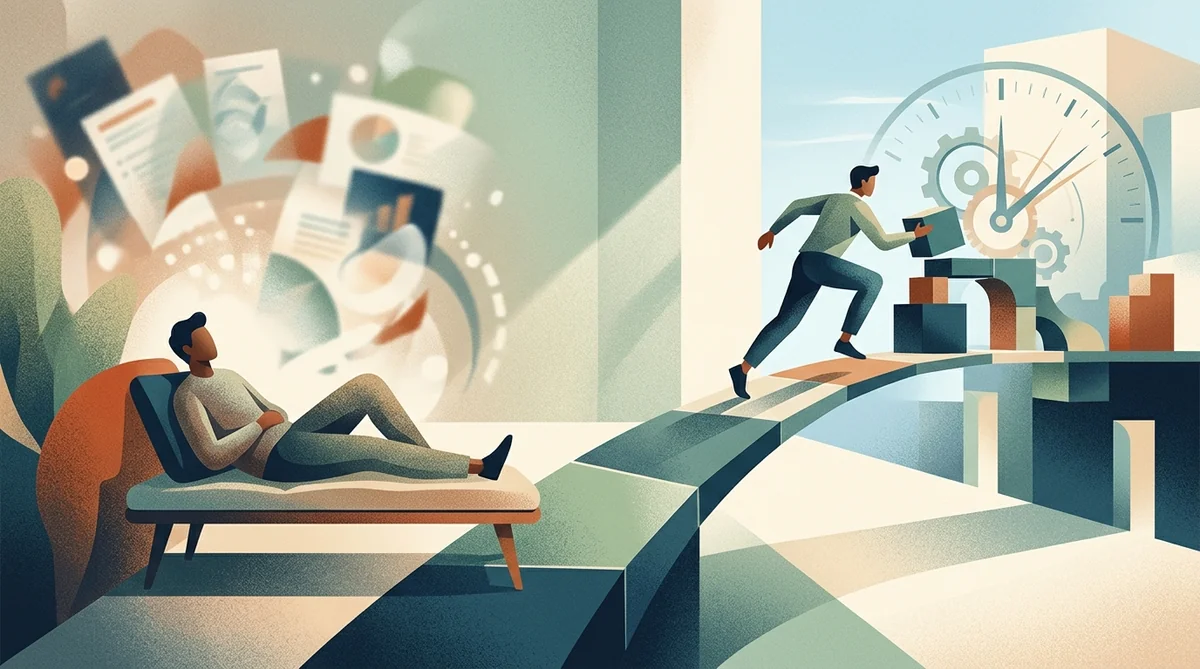
🎨 Editorial visualization: AI-generated illustration for eloptimista.soy.
The Hidden Cost of Irrational Loss Aversion
Why is it so hard for us to let go of the familiar, even when we know it no longer brings us value? The answer lies in how our brain processes potential losses versus future gains.
According to research compiled by InsideBE, status quo bias and decision inertia paralyze individual development potential. Loss aversion weighs much heavier in our everyday choices than the prospect of long-term improvement.
When you make decisions thinking solely about not losing what you've already built, your maneuvering room shrinks week after week. You stop exploring new tools, avoid proposing different ideas, and settle for doing the bare minimum.
Over time, that defensive posture completely alters your risk appetite. What started as prudence ends up turning into a fear of any move outside the usual script.
How Inaction Destroys Careers in VUCA Environments
We live and work in environments known as VUCA, marked by volatility, uncertainty, complexity, and ambiguity. In this scenario, sitting still and waiting for the storm to pass is not a viable strategy.
According to Harvard's Working Knowledge, paralysis based on a false sense of security is one of today's greatest threats. Uncertainty isn't resolved by avoiding risk, but with agility, solid information, and a rigorous diagnosis of each situation.
Furthermore, staying trapped in a stagnant routine out of fear of change also takes a toll on your daily energy. A framework from WorkSafeBC highlights that exhausting organizational conditions generate real cognitive and physical responses that lower your performance.

Stress-Test Your Plan Before the Market Does
If you want to break out of paralysis without acting blindly, the first step is to stop planning only for optimistic scenarios. You need to put your current professional plan through a real stress test before circumstances do it for you.
The framework proposed in Harvard Business Review suggests working backward from your ideal goal to spot fragile assumptions and blind spots. To do this practically, you can apply the so-called "5 Ds" (deceive, disrupt, degrade, deny, destroy):
- Deceive: What data or positive signals in your current job might be giving you false confidence?
- Disrupt: What technological or market shift could make your core task obsolete this year?
- Degrade: What habit of yours is slowly lowering the quality of your results?
- Deny: What key resource, contact, or skill are you missing today to make the next leap?
- Destroy: What would happen to your routine if your most stable project ended next quarter?

🎨 Editorial visualization: AI-generated illustration for eloptimista.soy.
Doing this exercise takes less than fifteen minutes, but it completely changes your perspective. You shift from protecting a sandcastle to building projects with real foundations.
Today I propose a direct micro-challenge: choose a decision you've been avoiding for weeks out of fear of losing comfort. Spend ten minutes writing down the worst that could happen if you take action—and what you're already losing if you stay the same—to take your first calculated step this very week.
Sources Consulted
- Harvard Business Review: Identify — and Mitigate — Risks to Your Career
- Psychology Today: Avoiding Risk Is Risky Business
- InsideBE: The Effect of Risk Aversion on Your Decision Making
- WorkSafeBC: Psychological health and safety: A framework for success
- Working Knowledge (Harvard): It's Time to Reset Decision-Making in Your Organization
Written by Félix Soler
Wellness & Psychology Editorial Team
Personaje editorial de El Optimista. Comparte pequeños hábitos diarios para superar el cansancio, organizarte mejor y vivir con calma.
Thematic editorial persona backed by our human curation team.