The 90-Second Micro-Break: Resetting Screen Fatigue
Have you ever wrapped up a remote workday feeling like your brain was crawling in slow motion? It's not physical muscle soreness from hitting the gym. It's that...


Table of Contents
- The invisible trap of nonverbal overload in daily work
- The mirror anxiety of constant self-view
- The physical stillness your brain interprets as a threat
- Why your eyes tire out before physical fatigue hits
- The ciliary muscle trapped in near vision
- The blink rate drop to 5 times per minute
- The 90-second protocol: anatomy of a micro-break
- The first 30 seconds: gazing into the horizon (>20 feet)
- Seconds 31 to 60: conscious blinking and belly breathing
- The final 30 seconds: shoulder and neck release
- Micro-breaks versus the afternoon crash: what empirical evidence proves
- How to build the habit without relying on raw willpower
- Sources
Have you ever wrapped up a remote workday feeling like your brain was crawling in slow motion? It's not physical muscle soreness from hitting the gym. It's that fuzzy mental fog that creeps in by mid-afternoon. You glance at the clock, it's barely 3 p.m., and reading 1 more email feels daunting.
The default reaction is blaming a lack of coffee or forcing yourself to power through.
Yet stacking hours without rest quietly sabotages your productivity. There is a simple, measurable, and zero-cost fix: the 90-second micro-break rule.
The invisible trap of nonverbal overload in daily work
Jumping across back-to-back video calls doesn't feel like chatting in person. The Virtual Human Interaction Lab at Stanford University pinpointed that digital exhaustion, widely known as zoom fatigue, stems from continuous nonverbal overload.
In a physical meeting room, you glance down at notes, stretch your arms, and shift your posture naturally. On camera, your brain interprets constant close-up faces as an intense state of social hypervigilance. It's an exhausting cognitive tax that drains your energy.
The mirror anxiety of constant self-view
Staring at a live video thumbnail of yourself for 4 hours a day isn't normal.
Stanford researchers warn that real-time self-view triggers subconscious self-evaluation, like working in front of a mirror all day. That involuntary scrutiny eats up valuable focus.
You'll catch yourself adjusting your posture or flashing an unnatural smile just to look engaged.
The physical stillness your brain interprets as a threat
A fixed webcam frame forces an unnaturally tight boundary on movement. To stay centered in the shot, your neck and shoulders lock into static tension, a hallmark of zoom fatigue.
The human body is built to shift weight and move naturally.
Forcing yourself to sit frozen chokes oxygenation and signals premature burnout to your nervous system.
Why your eyes tire out before physical fatigue hits
Often, that afternoon slump doesn't start in your major muscles or from deep workload stress. It begins in 2 small ocular components: the ciliary muscles and the corneal surface.

🎨 Conceptual reference illustration generated with AI for El Optimista. Does not represent the manufacturer's official design.
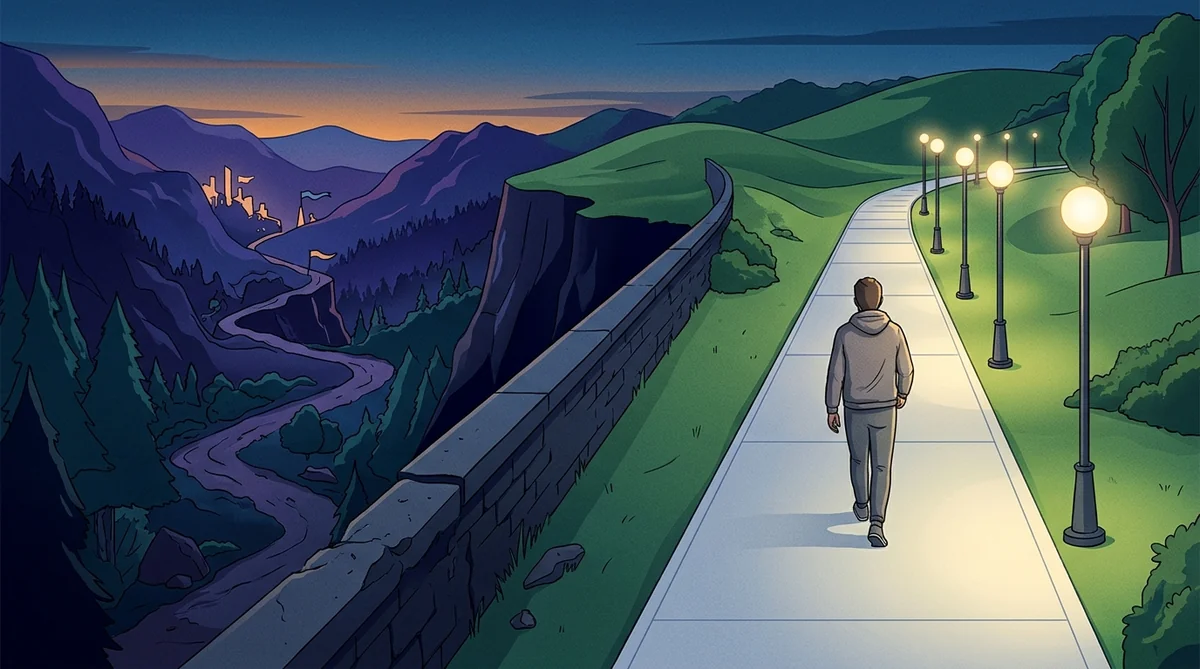
🎨 Editorial illustration crafted for El Optimista depicting visual rest and focal perspective.
When you stare at a monitor just 20 inches away, your eyes endure non-stop mechanical strain. Clinical literature on accommodative asthenopia captures that internal tension, sparking eye burn and blurred vision.
The ciliary muscle trapped in near vision
Picture holding a 4.5-pound dumbbell with your arm locked straight for 3 straight hours.
Even with modest weight, your muscle will cramp from a total lack of relaxation. That's exactly what happens to your ciliary muscle when staring at a single visual plane. Workplace workstation guidance from OSHA recommends shifting focal distances frequently to let muscle fibers regain elasticity.
The blink rate drop to 5 times per minute
During casual conversation, we naturally blink about 15 to 18 times every minute. Yet clinical data from the American Academy of Ophthalmology shows that facing a display drops that pace to 5 to 7 blinks.
Blinking less than half as often means tear film evaporates at record speed. You're left with that annoying gritty feeling, dry burn, and frontal tension headaches you'd otherwise blame on bad lighting.
The 90-second protocol: anatomy of a micro-break
You don't need to halt your day for 30 minutes or ditch your scheduled meetings. The beauty of micro-breaks lies in non-linear attentional recovery: 90 deliberate seconds are enough to reboot your nervous system.
This protocol doesn't require complex gadgets or fancy software.
You only need a subtle cue or the end of a work block to cycle through 3 sequential 30-second steps.

🎨 Conceptual reference illustration generated with AI for El Optimista. Does not represent the manufacturer's official design.
🎨 Visual guide for El Optimista breaking down focal disengagement, blinking, and posture resets.
Turn your gaze away from the screen toward the furthest spot available, preferably an open window with trees.
If you're in an enclosed room, aim for the highest, most distant corner at least 20 feet away. Gazing into the distance lets your ciliary muscle relax instantly via natural reflex. It's like dropping that dumbbell and resting your forearm on the desk.
The first 30 seconds: gazing into the horizon (>20 feet)
Resting your focal depth is the foundation of the entire reset.
Seconds 31 to 60: conscious blinking and belly breathing
During this second stretch, close your eyes gently and take 10 deliberate, slow blinks.
Each full lid closure restores the natural lipid layer across your cornea. Pair each blink with a deep 4-second nasal breath, feeling your lower belly expand. Exhale slowly through your mouth for 6 seconds to dial down sympathetic nervous arousal.
The final 30 seconds: shoulder and neck release
To complete the sequence, lift your spine off the chair back and roll your shoulders backward 3 times. Let your arms hang loosely at your sides and gently turn your neck from side to side.
Ergonomic protocols from CCOHS highlight how these micro-adjustments relieve upper-trap compression and restore healthy blood flow toward your head.
Micro-breaks versus the afternoon crash: what empirical evidence proves
Traditional hustle culture taught us that grit means parking in a desk chair at 9 a.m. and staying put until lunch.
Yet behavioral studies confirm that human attention takes a steep nosedive after 45 continuous minutes of fixed visual focus.
| Work Schedule | Eye Strain Impact | Mental Clarity at 4 p.m. | Daily Time Investment |
|---|---|---|---|
| Continuous sitting (3 to 4 h) | Severe dryness and asthenopia | 40% drop in concentration | 0 min (with 2 h of sluggish output) |
| Traditional single break (30 min) | Belated temporary relief | Partial energy recovery | 30 accumulated min |
| 90-second micro-breaks (every 40 min) | Relaxed ciliary tone and stable tears | Sustained focus and calm | 12 total distributed min |
Weaving small pockets of relief preserves your mental stamina across the whole workday. Here is how your autonomic nervous system responds depending on your break habit:
flowchart TD
    A["Screen work session underway"] --> B{"Take a micro-break at 40 min?"}
    B -- "No: Keep staring at display" --> C["Ciliary strain and nonverbal fatigue"]
    C --> D["Severe mental fog by 3 p.m."]
    D --> E["Procrastination and frontal headache"]
    B -- "Yes: 90-second conscious reset" --> F["Distance gaze + mindful blinking"]
    F --> G["Cortisol drop and tissue oxygenation"]
    G --> H["Return to focused flow with clarity"]
How to build the habit without relying on raw willpower
The biggest hurdle in protecting your eyesight isn't mechanical difficulty; it's forgetting to do it. When you're deep in a project or finalizing a pitch deck, time slips away unnoticed.
The secret is tethering the pause to existing contextual triggers in your daily routine. You don't need obnoxious alarm buzzers that disturb teammates; simply link the micro-break to natural shifts already happening around you.
💡 Consejo Pro
3 daily anchors to automate your micro-breaks: 1. Call conclusion transition: The moment you end a video call, resist immediately pulling up your inbox.
Protecting your workplace stamina doesn't demand radical weekend retreats or drastic overhauls.
Often, the difference between finishing your shift burned out and preserving energy for your personal life comes down to 90 seconds of clarity.
Sources
- Stanford University — Virtual Human Interaction Lab: Groundbreaking research on nonverbal overload and video exhaustion.
- OSHA Workstation Standards: Ergonomic guidelines for computer monitors and eye strain prevention.
- American Academy of Ophthalmology: Clinical insights into reduced blink rates and screen habits.
- CCOHS Office Ergonomics: Practical ergonomic positioning and active micro-pauses.
- Wikipedia — Zoom fatigue: Academic overview of videoconferencing exhaustion.
- Wikipedia — Asthenopia: Physiological overview of accommodative and ocular fatigue.
Written by Félix Soler
Wellness & Psychology Editorial Team
Personaje editorial de El Optimista. Comparte pequeños hábitos diarios para superar el cansancio, organizarte mejor y vivir con calma.
Thematic editorial persona backed by our human curation team.