Task Management and Deep Work: The 3-2 Hybrid Formula
Discover how the 3-2 hybrid formula protects your focus, reduces meeting fatigue, and helps you end each day with real momentum.


Table of Contents
- The Retention Crisis Behind Mandatory Office Attendance: The Invisible Toll
- Fixed Synchronization vs. Unstructured Flexibility: Inside the 3-2 System
- Quantitative Results: The Hard Data That Convinced Executive Leadership
- Essential Toolkit to Protect Your *Deep Work* Blocks
- A 10-Minute Friday Audit to Protect Next Week's Focus
- Sources
Ever shut down your laptop at five o'clock with the nagging feeling that you ran a marathon without ever leaving the starting blocks? Between status meetings that could have been handled in a quick update, soul-crushing two-hour commutes, and open-plan offices that feel more like busy train stations, our bandwidth for clear, deep thinking usually gets chewed to pieces.
For years, we were handed a false binary: either embrace full remote isolation—the kind that can quietly chill spontaneous collaboration—or endure five mandatory days in a cubicle just to answer emails under supervisory glare. When global travel giant Trip.com attempted a blanket return-to-office mandate, the operational fallout was swift: senior engineers walked, key analysts resigned, and recruitment expenses soared.
The real breakthrough didn't come from a corporate cheerleading session or a feel-good slogan. It came out of a rigorous field experiment designed by Stanford University economist Nicholas Bloom and his research team. Their answer?
The 3-2 hybrid formula: a synchronized scheduling framework that slashed quit rates by 33% while proving that safeguarding two quiet, non-negotiable focus days at home yields far more business value than an entire week trapped in conference rooms.
The Retention Crisis Behind Mandatory Office Attendance: The Invisible Toll
Battling gridlock at eight in the morning burns through more cognitive fuel than hours of architectural design or deep coding. Commuting ninety minutes each way just to sit in a booth and dial into a video call with a teammate three desks over isn't merely frustrating—it actively drains the momentum of capable professionals.
That persistent friction pushed this global travel operator into an expensive corner. Replacing a senior software engineer or a lead financial analyst meant months of open requisitions, lost productivity, and hefty headhunting fees. To tackle this talent leak with empirical rigor, Nicholas Bloom set up a randomized controlled trial tracking 1,612 university-educated employees across tech and operations to see what actually happens when you abandon conventional office dogma.
The sharpest pushback initially came from middle management. Ahead of the pilot, the 395 participating team leads projected an average drop of -2.6% in departmental output if employees were out of sight two days a week. Physical presence remained the only metric many supervisors trusted to measure dedication.
Yet the findings published in Nature on retention and performance in hybrid structures painted a fundamentally different picture: compulsory face time routinely rewarded performative busyness while quietly sabotaging progress on high-leverage priorities.
💡 Consejo Pro
Sustainable productivity isn't about logging endless hours at a desk; it's about building clear agreements where office days serve shared dialogue and home days protect deep, uninterrupted thinking.
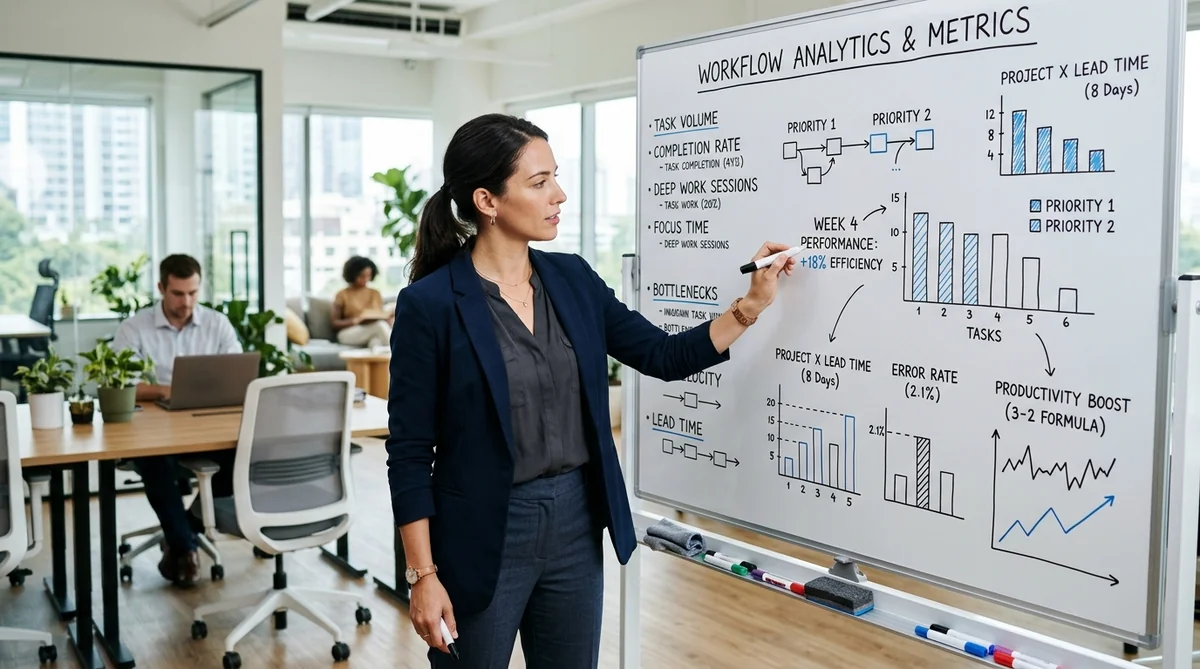
🎨 A collaborative workspace designed for strategic coordination and core projects.
Fixed Synchronization vs. Unstructured Flexibility: Inside the 3-2 System
Many companies tried weathering the hybrid transition by granting total, unguided flexibility—telling everyone to simply show up whenever they felt like it. The result was often messy. Without shared rhythms, people drove in on a Tuesday only to spend the day alone in a phone booth, while offices stood completely vacant by Friday afternoon.
The framework validated by Stanford doesn't advocate calendar chaos; it relies on deliberate collective synchronization. Team members report to the office on the exact same three anchor days—typically Monday, Tuesday, and Thursday—with an explicit focus on face-to-face working sessions, cross-functional roadblocks, strategic alignment, and onboarding newer talent.
Conversely, the remaining two days—Wednesday and Friday—are strictly guarded for remote work under an intentional rule of minimal interruptions. That reliable boundary unlocks uninterrupted four-hour stretches to write clean code, model financial forecasts, or craft long-term roadmaps without getting pulled into spontaneous sidebar chatter.
flowchart LR
    A[3-2 Workweek] --> B[Synchronous Days: Mon-Tue-Thu]
    A --> C[Asynchronous Days: Wed-Fri]
    B --> D[In-Person Collaboration & Mentorship]
    C --> E[Uninterrupted Deep Work]
Focus isn't the absence of distractions. It's having a project that excites you more than they do—and having a protected pocket of time where your ideas can actually take shape.
Quantitative Results: The Hard Data That Convinced Executive Leadership
Managerial skepticism evaporates when the numbers demonstrate clear operational upside. Over the six-month trial and the two years of longitudinal tracking that followed, the Stanford research team measured outcomes across two distinct cohorts: staff working five days in the office versus those on the 3-2 schedule.
The data dispelled executive hesitation and established an objective baseline for balancing sustainable pacing with high output.
| Measured Metric | Control Group (5 Days In-Office) | Hybrid 3-2 Group (Stanford) | Documented Impact |
|---|---|---|---|
| Voluntary Turnover Rate | Standard corporate attrition baseline | Substantial drop in resignations | -33% turnover (p < 0.01) |
| Performance Reviews & Promotions | Baseline biannual performance ratings | Identical rate of career advancement | Null statistical difference (zero career penalty) |
| Software Engineering Output | Standard in-house production deploys | Equal code commit volume and quality | Total stability across key deliverables |
| Managerial Output Perception | Pre-trial expectation of -2.6% drop | Post-trial retrospective review | +1.0% net perceived gain |
Detailed reporting from the Stanford Institute for Economic Policy Research revealed that the 33% reduction in resignations was especially pronounced among non-managerial specialists and staff facing commutes longer than 45 minutes each way.
Once executive leadership saw that technical velocity remained rock-solid and hybrid employees earned promotions at the exact same pace as their full-time in-office peers, the debate ended: this major organization rolled out the 3-2 schedule across its entire corporate roster worldwide.

🎨 A quiet, distraction-free environment for deep individual focus sessions.
Essential Toolkit to Protect Your Deep Work Blocks
Adopting a similar cadence in your own routine—or across your immediate project team—doesn't require an overwhelming software stack. In fact, cluttering your screen with half a dozen workflow apps usually creates more friction than clarity. You only need simple, dependable tools that draw a sharp boundary between quick communication and sustained, solitary focus.
To build that structure without complicating your day, consider these core assets:
- Structured Note Systems (such as Notion or Obsidian)
- Why it works: Keeps quick coordination dashboards—such as sprint agendas and client action items—cleanly separated from deep research wikis and long-form planning documents.
- The trade-off: Its infinite flexibility can become a time trap if you spend hours styling templates instead of finishing meaningful work.
- Project Visibility Boards (such as ClickUp or Trello)
- Why it works: Ties broader project deliverables directly to individual task deadlines, making it effortless to map high-concentration work directly onto your remote focus days.
- The trade-off: A feature-dense interface that can feel cluttered if your team prefers simple, minimalist boards.
- Analog Anchors (A physical desk timer and closed-back headphones)
- Why they work: A dedicated countdown timer on your desk sets a visible, tactile boundary: fifty uninterrupted minutes dedicated to a single priority before opening any browser tabs or communication apps.
- The trade-off: Requires establishing clear social expectations with teammates or family so they know the running timer means zero drop-in interruptions.
💡 Consejo Pro
Apply the minimum-system rule: if an organizational tool demands more than ten minutes a day just to maintain tags and restructure task lists, it's quietly stealing time you should be using to create.
Real productivity isn't about packing your calendar with secondary tasks. It's about sitting down at your desk and knowing exactly what matters next without burning mental energy to decide.
A 10-Minute Friday Audit to Protect Next Week's Focus
You don't have to wait for an enterprise-wide mandate to reclaim control over your calendar. You can apply the principles of the Stanford study to your own week by spending ten focused minutes every Friday afternoon or Monday morning.
Run through this quick checklist before your days pick up speed:
- Meeting Triage: Did I pinpoint and cut at least one routine status call that could easily be handled through a concise asynchronous update?
- Batch Scheduling: Are client touchpoints, team catch-ups, and one-on-ones clustered onto two or three designated collaborative days?
- Shielded Focus Blocks: Have I blocked two uninterrupted morning focus sessions on my calendar as non-negotiable holds to deter surprise invites?
- Response Windows: Have I aligned with collaborators on what truly requires immediate attention versus messages that can wait for a two-to-three-hour window?
- Frictionless Workspace: Is my physical desk cleared of clutter, with my focus timer ready so I can dive straight into priority work without hesitation?
Routines that unlock serious productivity don't feel heroic, nor do they require fourteen-hour grind sessions. They feel smooth, predictable, and sustainable week after week.
Start with what's sitting on your desk today. When you structure your schedule around dedicated deep-work blocks, you don't just elevate the quality of your output—you get back that quiet, invaluable satisfaction of ending the workday knowing you actually moved the needle on what counts.
Trademark Disclaimer: All trademarks, logos, and brand names cited (including Notion, Obsidian, ClickUp, Trello) are the property of their respective owners. Their mention in this publication is strictly for educational and instructional purposes under nominative fair use principles, with no affiliation, endorsement, or sponsorship by the trademark holders.
Sources
- Stanford Institute for Economic Policy Research (SIEPR): Hybrid work is a “win-win-win” for companies, workers — Rigorous randomized controlled trial findings on hybrid scheduling, employee retention, and productivity across 1,600 professionals.
- Stanford University Report: Study finds hybrid work benefits companies and employees — Strategic coordination analysis and objective software engineering output metrics under the 3-2 model.
- Nature / PubMed: Hybrid working from home improves retention without damaging performance — Peer-reviewed scientific study (Nicholas Bloom et al., DOI: 10.1038/s41586-024-07500-2) tracking long-term employee retention and career progression.
- National Bureau of Economic Research (NBER): How Hybrid Working From Home Works Out — NBER Working Paper 30292 evaluating work-hour reallocation, job satisfaction, and sustainable focus rhythms.
Written by Félix Soler
Wellness & Psychology Editorial Team
Personaje editorial de El Optimista. Comparte pequeños hábitos diarios para superar el cansancio, organizarte mejor y vivir con calma.
Thematic editorial persona backed by our human curation team.

Smart Rings: Why Professionals Are Ditching Wrist Screens at Work
Deep Work Tools: Why Real Focus Demands Room for Doubt